Repetition built your comfort zone. Repetition will build your freedom.
Most of what feels natural to you was once practiced.
The way you react under pressure, the thoughts you return to when uncertainty appears, the standards you accept, the conversations you avoid, the routines you follow without thinking, none of these arrived fully formed. They became familiar because you repeated them. Familiarity eventually began to feel like personality.

That is one reason change can seem harder than it is. We often treat the comfort zone as a fixed boundary, as though some invisible line has been drawn around who we are. Yet much of that boundary is simply accumulated repetition. You have walked certain mental and behavioral paths so many times that they now feel like home.
A path through a field offers a useful image. The first time someone crosses tall grass, every step requires attention. After a hundred crossings, a trail appears. Eventually, you follow it almost automatically because the ground itself seems to guide you.
Your habits work much the same way.
Repeat hesitation often enough and hesitation becomes the easiest route. Keep saying yes when you mean no and compliance begins to feel normal. Delay the difficult conversation again and again and avoidance starts to look like peace. Spend years doubting your own judgment and seeking permission can begin to feel like responsibility.
The comfort zone is built through these small rehearsals.
This is good news, because the same mechanism that created limitation can create freedom.
Freedom is sometimes imagined as escape from discipline. Yet the deepest forms of freedom often emerge through deliberate repetition. A musician becomes free at the piano because scales have been practiced thousands of times. An athlete moves with grace because basic movements have been rehearsed until the body no longer needs to negotiate every detail. Someone who has practiced speaking truthfully can enter a difficult conversation with a freedom that chronic avoidance never provides.
Repetition removes friction.
At first, the new behavior may feel awkward precisely because it has no path yet. You are stepping into tall grass. There is resistance underfoot. Your old route remains clearer, easier and more inviting.

This is where many people misread discomfort. They assume that because something feels unnatural, it must somehow be wrong for them. Often, the unfamiliar feeling simply means the repetition has not happened yet.
Consider someone who wants to protect an hour each morning for meaningful work. Their existing pattern might be to wake, check messages, respond to other people’s requests and enter the day already scattered. That routine feels effortless because it has been rehearsed for years.
The first morning they leave the phone untouched and sit down to create may feel strangely uncomfortable. The second may feel little better. By the twentieth, something begins to shift. Attention arrives more quickly. The urge to check messages weakens. What once required discipline starts becoming a rhythm.
Eventually, the freedom to focus is no longer something they must fight for each morning. They have practiced themselves into it.
This changes the way you can think about personal growth. You do not need to manufacture a new identity through force. You can give a chosen way of living enough repetition that it becomes familiar.
The question becomes less dramatic: What am I rehearsing?
Every repeated action is teaching you something about how to live. Each time you honor a boundary, you practice self respect. Every time you return to the work after distraction, you practice focus. When you keep a small promise to yourself, you practice trust. Whenever you sit with discomfort instead of immediately escaping it, you expand your capacity to remain present.
These moments can look almost insignificant from the outside. Their power comes from accumulation.
A single brick does not resemble a house, yet houses are built from bricks. In the same way, one courageous choice may appear too small to change a life. Repeat that choice often enough and it becomes part of the structure you live inside.


This is also why occasional intensity matters less than we tend to believe. A heroic effort can produce a memorable day. Repetition creates a different kind of result. It changes what becomes normal.
There is something deeply hopeful in that.
You are already skilled at repetition. Your current life proves it. You have practiced certain ways of thinking, choosing and responding until they became nearly effortless. The task now is to become more conscious about what deserves another rehearsal.
Choose carefully what you repeat, because repetition eventually disappears from view. The behavior becomes rhythm, the rhythm becomes character, and character shapes the range of choices that feel available to you.
Freedom, then, may be quieter than expected. It can begin with the same small action performed tomorrow, and then again the day after that, until a new path becomes easier to walk.
You built familiarity once. You can build it again.
And with enough conscious repetition, what feels difficult today can become the place from which you move freely.
Chief Editor
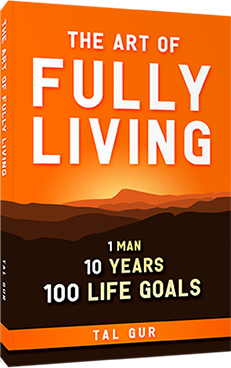
 Tal Gur is an impact-driven creator at heart. After trading his daily grind for a life of his own design, he spent a decade pursuing 100 life goals around the globe. Tal's journey and recent book, The Art of Fully Living, inspired him to found Elevate Society.