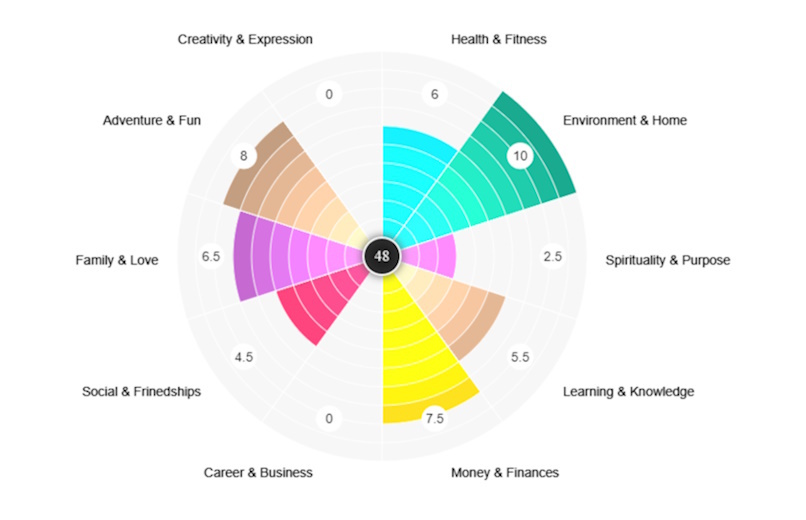
What you pursue reflects who you believe you are.
We often think our goals are pointing toward the future. Look closely, and you may discover they are quietly revealing the present.
Every pursuit begins with an assumption about who you are.

You may pursue recognition because some part of you believes being seen will make you significant. You may pursue wealth because you associate freedom with having more options. You may pursue mastery because excellence feels like an honest expression of your nature. Even the desire for peace can reveal something about how you see yourself and what you believe life should feel like.
This is what makes goals so revealing. They seem to describe where you want to go, yet they often expose the identity standing at the starting line.
Two people can pursue the same outcome for completely different reasons. Both may want to build a successful business. One sees success as proof that they matter. The other sees the business as a useful vehicle for creating, contributing, and living with greater freedom.
From the outside, their calendars may look similar. Their inner experience will be very different.
One pursuit carries a hidden demand: Make me enough.
The other carries an expression: This is something I want to bring into the world.
That difference eventually touches everything. It shapes how much pressure you place on yourself, what compromises you tolerate, how you respond when progress slows, and whether achievement leaves you satisfied once it arrives.
A goal is therefore more than a destination. It is a mirror you agree to walk toward.
The interesting part is that we rarely examine the reflection.

We spend enormous energy asking whether a goal is realistic, measurable, ambitious, or worth the effort. Those questions matter. Yet another question often reaches deeper: What would I have to believe about myself for this pursuit to feel necessary?
Imagine someone who keeps chasing bigger titles at work. Each promotion brings satisfaction for a few months, then another position begins to look essential. The obvious conclusion is that this person is highly ambitious.
Perhaps.
A closer look may reveal an identity built around being impressive. If advancement has become the main evidence of worth, no title can finish the job. Each achievement creates a temporary feeling of arrival before the old uncertainty returns.
The problem is no longer the size of the goal. The deeper issue sits beneath the goal, quietly deciding what success is supposed to repair.
This is where conscious ambition becomes powerful.
You can still pursue difficult things. You can build, earn, lead, create, train, explore, and grow. There is no wisdom in shrinking your life simply to prove that you are detached from achievement.
The invitation is to choose from a clearer place.
Think of a compass placed beside a magnet. The compass still works, yet the nearby force bends its reading. In the same way, a hidden belief about yourself can bend the direction of your ambition. You may feel certain that you are following desire while an old identity is quietly pulling the needle.


Perhaps you believe you must be useful to deserve love. You may then fill your life with responsibilities that make you indispensable.
Perhaps you believe safety comes from control. You may pursue certainty so intensely that spontaneity begins to feel irresponsible.
Perhaps you believe you are capable of meaningful contribution. That belief can also shape a pursuit, leading you toward work that asks more of your gifts.
Identity does not always distort desire. Sometimes it gives desire its cleanest direction.
This is why the answer is rarely to stop wanting things. It is to become interested in the self doing the wanting.
Before committing to a major goal, try sitting with a few simple questions. What do I imagine this achievement will say about me? How would I feel about myself if nobody ever knew I accomplished it? If this goal disappeared tomorrow, what part of my identity would feel threatened?
The answers can be uncomfortable, though discomfort here is useful. It gives you information.
You may discover that a pursuit you considered essential has been carrying a burden it was never designed to hold. A career cannot permanently establish your worth. A relationship cannot complete your identity. A bank balance cannot settle every fear. Recognition cannot give you a stable sense of self if your own approval remains absent.
Once you see that clearly, ambition becomes lighter.
You can pursue wealth without asking money to tell you who you are. You can seek recognition without becoming dependent on applause. You can build something extraordinary while remaining whole during the unfinished years.
There is an important inversion here. We tend to believe that achieving certain things will allow us to become certain people. Often the more powerful move is to become deliberate about who we believe we are, then allow our pursuits to grow from that ground.
A tree does not chase its fruit. The fruit emerges from the health of the tree.
Your pursuits work in a similar way. What you repeatedly reach toward grows from the beliefs, values, fears, and possibilities you carry within yourself.
So pay attention to what keeps calling you forward. Your ambitions are giving you information. Some may reveal identities ready to be released. Others may point toward qualities already alive in you and waiting for fuller expression.
Choose goals that feel worthy of the person you are becoming, while remembering that no achievement gets to decide your value.
Then pursuit changes character. It becomes less about earning an identity and more about giving one form.
And perhaps that is one of the cleanest ways to live with ambition: know who you are deeply enough that what you pursue becomes an expression of your life, rather than an attempt to justify it.
Chief Editor
 Tal Gur is an impact-driven creator at heart. After trading his daily grind for a life of his own design, he spent a decade pursuing 100 life goals around the globe. Tal's journey and recent book, The Art of Fully Living, inspired him to found Elevate Society.